Plantar Fasciitis (Heel Spur) Treatment
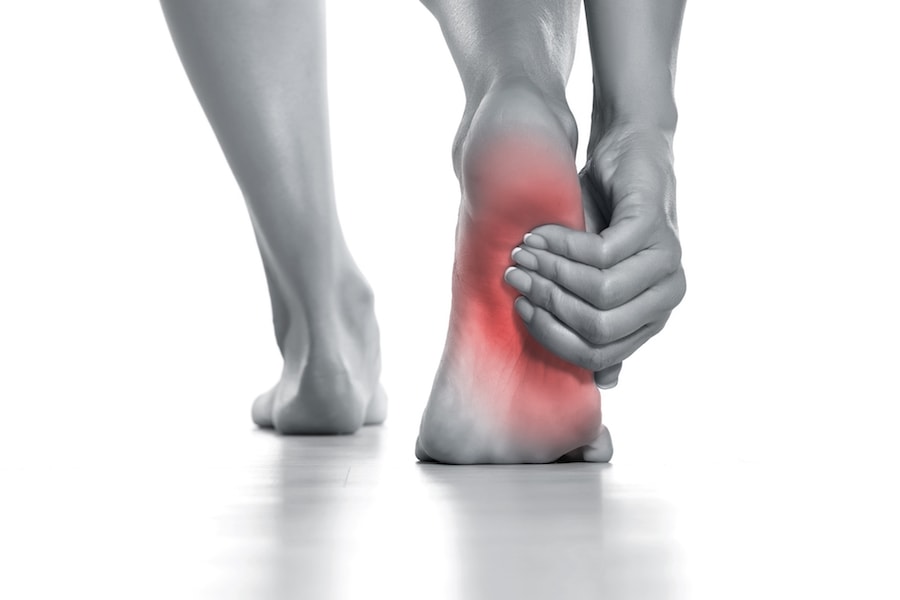
What is plantar fasciitis (heel spur)?
Plantar fasciitis is one of the most common causes of foot pain. It occurs when the plantar fascia – a thick band of connective tissue that supports the arch of the foot and connects the heel bone to the toes – becomes inflamed or damaged.
Morning pain
Sharp, stabbing pain under the heel with the first steps after waking up or after prolonged sitting.
Pain when standing
Intense discomfort under the heel during prolonged standing or walking.
Localized pain
Pain is precisely defined – in the inner edge of the heel, at the attachment point of the plantar fascia.
Worsening pain
Pain intensifies throughout the day with increased activity or after prolonged rest.
What causes plantar fasciitis?
Plantar fasciitis usually occurs due to the following reasons:
- Overloading: Excessive running, prolonged standing, or suddenly increased physical activity
- Foot anatomy: Flat feet, high arch, or abnormal gait
- Age: Most common between ages 40-60
- Excess weight: Adds pressure to the plantar fascia
- Inappropriate footwear: Poor support or cushioning
- Tight Achilles tendon: Affects foot mobility
⚡ Shockwave Therapy: Precision Technology for Your Foot
Shockwave therapy is one of today's most effective non-invasive treatment methods for plantar fasciitis. It uses controlled acoustic waves that:
🎯 Stimulate healing
Acoustic waves trigger neovascularization (new blood vessel growth) in the damaged area, increasing blood circulation and metabolism[1][2].
💥 Support tissue repair
Waves help break down damaged tissue formed as a result of chronic inflammation, triggering the body's natural tissue repair process[2].
🔬 Stimulate collagen production
Triggers the body's natural collagen production, which is necessary for forming strong and healthy connective tissue[3].
⚡ Reduce pain
Affects pain-transmitting nerve fibers (hyperstimulation analgesia), so the pain signal reaches the brain more weakly[4].
How does shockwave therapy work?
📅 Treatment Course: 7 sessions (3-4 weeks)
🎯 Session 1: Diagnosis and first treatment
Duration: 30-40 minutes
Goal: Determining the exact pain point and first activation of the treatment device.
🔄 Sessions 2-4: Intensive treatment phase
Frequency: 2-3 times per week
Goal: Breaking down scar tissue, reducing inflammation, activating blood circulation, and initiating healing processes.
📈 Sessions 5-7: Result consolidation
Frequency: 1-2 times per week
Goal: Supporting the formation of new, healthy connective tissue and stabilizing results.
📈 Post-treatment expectations
After the treatment course, recovery occurs on average 1.5 months, after which the treatment results can be felt. If symptoms persist, the course should be repeated.
Who can benefit from shockwave therapy?
Shockwave therapy is suitable for most people suffering from plantar fasciitis.
✅ Suitable for you if...
- You suffer from chronic heel pain for more than 6 weeks
- Morning steps are painful
- Regular treatment (rest, stretching, anti-inflammatory) hasn't helped
- You want to avoid injections or surgery
- You're an athlete and need quick recovery
- You've tried orthopedic insoles without results
- Pain interferes with daily movement and quality of life
❌ Not suitable if...
- You are pregnant
- You have a pacemaker in the treatment area
- There is an active infection in the foot area
- Pain occurred suddenly after trauma (fracture must first be ruled out)
Why is shockwave therapy effective?
Scientific studies show good results in treating plantar fasciitis, though results vary between studies:
📊 Proven results
Success rate: Clinical studies have shown an average success rate of up to 81% in treating heel spur and plantar fasciitis[5]. Medium-energy shockwave therapy has shown statistically significant improvement at all follow-up points (3, 6, and 12 months) in meta-analysis[6].
⚡ Experience from similar conditions
Wider context: A similar 60-80% success rate has been observed in treating other tendon conditions (e.g. tennis elbow, shoulder tendinopathy) with shockwave therapy[7].
🔬 Tissue-level changes
Measurable improvement: Ultrasound studies show a reduction in plantar fascia thickness after treatment, confirming a physical tissue change, not just subjective pain reduction[8].
🌿 Safe and non-invasive
Low risk level: Requires no medication, injections, or surgery, making it a common first choice before considering more invasive methods[2].
🧲 Combined approach: shockwave therapy + high-intensity magnetic therapy (EMTT)
MV Therapy also offers high-intensity magnetic therapy (EMTT) in addition to shockwave therapy for treating plantar fasciitis. These are two different, complementary technologies:
- Shockwave therapy: mechanical energy that stimulates direct tissue healing and neovascularization in the treatment area
- EMTT: high-frequency magnetic field (100-300 kHz) that penetrates deeper into tissue and modulates inflammation over a wider area, without heating the tissue[10]
A randomized controlled trial (86 patients) testing the combination of EMTT and shockwave therapy in treating tendinopathy showed better pain and function improvement with the combined approach[11].
- Wang CJ, et al. Shock wave therapy induces neovascularization at the tendon-bone junction. PubMed
- Extracorporeal shock wave therapy mechanisms in musculoskeletal regenerative medicine. PMC
- Bosch G, et al. The effect of focused extracorporeal shock wave therapy on collagen matrix and gene expression. PubMed
- Extracorporeal shockwave therapy for chronic proximal plantar fasciitis. PubMed
- Extracorporeal shock wave therapy mechanisms in musculoskeletal regenerative medicine (success rate data). PMC
- Efficacy of Different Energy Levels Used in ESWT for Plantar Fasciitis: Meta-Analysis. PMC
- Extracorporeal shockwave therapy for plantar fasciitis and gastrocnemius muscle: effectiveness of combined treatment. ResearchGate
- Comparison of the Short-Term Effect between Iontophoresis and Radial ESWT in Plantar Fasciitis. PMC
- Extracorporeal shock wave therapy for plantar fasciitis: randomised controlled multicentre trial. PMC
- What Is EMTT Therapy? Mechanism and tissue penetration. Healthworks
- Hollander K, et al. Extracorporeal magnetotransduction therapy (EMTT) for management of musculoskeletal disorders. SAGE Journals (cites: Electromagnetic transduction therapy and shockwave therapy in 86 patients with rotator cuff tendinopathy, Electromagn Biol Med 2018;37:175-183)
ℹ️ The information on this page is for informational purposes only and does not replace professional medical diagnosis or treatment.
Don't let pain limit your life
Every step doesn't have to be painful. Shockwave therapy will help your foot move freely again – in a natural and safe way. Start your journey to recovery today!
Most important questions
Book appointment for this condition: