
Therapeutic Sports Massage in Tallinn
📍 Service available: Tallinn (Viimsi Hospital, Ravi tee 4) · Pärnu (Rüütli 47)
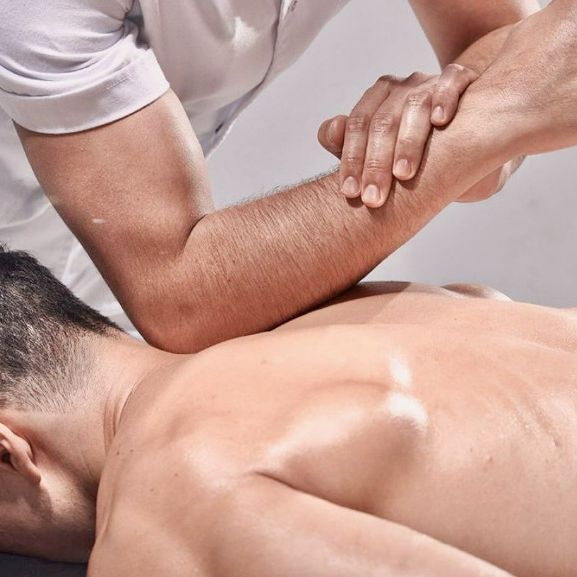
Who is therapeutic sports massage for?
Therapeutic sports massage is suitable for every physically active person who wants not just to recover, but to actively develop the functional capacity of their body.
Two approaches, one goal
Therapeutic sports massage is applied at two different times with different objectives - but both centre on ensuring the body's optimal working capacity.
Activating pre-training massage
Performed 2–3 days before training or competition. The goal is to bring the muscles into an optimal active state - not simply warming up, but raising neuromuscular readiness. Massage is not performed less than 3 days before a competition.
- Increases muscle receptivity and reaction speed
- Activates motor units in deeper layers
- Improves muscle coordination and proprioception
- Prepares musculotendinous junctions for load
- Reduces injury risk through optimal tone
Restorative post-training massage
Performed 30 minutes to 6 hours after training or competition. The goal is to accelerate recovery so that the body is ready for the next session not just rested, but functionally stronger.
- Normalises muscle tone after overload
- Accelerates removal of metabolic waste from tissues
- Restores muscle elasticity and optimal length
- Prevents chronic adaptive dysfunctions
- Supports quality structural recovery of the muscles
Why regular sports massage and a therapeutic approach give different results
Regular sports massage often follows a learned, fixed sequence of movements – the same techniques, in the same order, regardless of who is lying on the table. Therapeutic sports massage instead starts from three things: your anatomy and movement patterns, coexisting health conditions, and the specific demands of your particular sport.
🎯 Individualized, not standardized
The development of massage programs for elite athletes emphasizes that effective massage is individualized both to health condition and to specific performance goals – not a one-size-fits-all protocol[2].
🏃 The sport itself shapes the outcome
A randomized trial of 150 athletes found that team and strength-sport athletes achieved statistically significantly greater performance improvement from massage than individual and endurance-sport athletes (p=0.004)[3]. The same massage doesn't produce the same result across every sport – accounting for sport-specific demands is part of what makes it effective.
📡 Proprioception – the movement feedback system
Proprioceptors located in muscles, tendons, and joints (muscle spindles, Golgi tendon organs, joint receptors) continuously provide the central nervous system with information on muscle length, tension, and joint position[1]. Understanding how these work is the foundation for understanding why and how a specific technique improves neuromuscular control.
🩻 Movement pattern assessment finds the cause, not just the symptom
Understanding biomechanics and movement patterns allows a therapist to identify faulty movement patterns that lead to injury and address the root cause of the problem, rather than just the symptom[4].
When a therapist knows your anatomy, takes into account coexisting health conditions, and understands the typical loading patterns of your sport, the same technique – neuromuscular therapy, PNF stretching, fascial release – becomes a precisely calibrated tool, not a rehearsed routine.
- Purves D, et al. Mechanoreceptors Specialized for Proprioception. Neuroscience, 2nd edition. NCBI Bookshelf
- A Standardized, Evidence-Based Massage Therapy Program for Decentralized Elite Paracyclists: Creating the Model. PMC
- Deep Tissue Massage Therapy: Effects on Muscle Recovery and Performance in Athletes. PMC
- What Knowledge Does a Sports Massage Therapist Need? Biomechanics and movement pattern assessment. ICGI
ℹ️ The information on this page is for informational purposes only and does not replace professional medical diagnosis or treatment.
Therapeutic techniques
Therapeutic sports massage uses specific neuromuscular and manual therapy techniques that act on the body at a deeper level than conventional massage:
Neuromuscular therapy
Work focused on optimising the cooperation between muscles and nerves. Precise targeting of trigger points releases reflexive spasms and restores normal motor control.
PNF stretching techniques
Proprioceptive neuromuscular facilitation simultaneously increases mobility and muscle tone by harnessing the body's natural reflex mechanisms.
Muscle activation techniques
Targeted work with inhibited or "switched off" muscles. Their reactivation improves inter-muscular coordination and the efficiency of force transfer.
Myofascial release
Deep tissue work at the level of the fascia improves tissue glide, increases range of motion and optimises force transfer along the full length of the kinetic chain.
Why does a therapeutic approach change results?
Increasing muscle tone
Optimal muscle tone does not mean tension - it means the right level of readiness in the muscle. Too low a tone (hypotonus) reduces force transfer and increases injury risk. Therapeutic sports massage restores and maintains the neuromuscular level needed for athletic performance.
Improving athletic results
When muscles work in coordination, reaction speed is optimal and range of motion is full, athletic performance improves without additional training. Therapeutic sports massage removes the functional barriers that hold results back.
Injury prevention
Most sports injuries don't happen by chance - they have precursors: tone imbalances, inhibited stabilisers, reduced proprioception. Therapeutic sports massage identifies and corrects these risk factors before they become injuries.
Staying healthy
Regular therapeutic sports massage is not just recovery - it is a preventive investment. A body whose muscles work in a balanced, coordinated way tolerates load better, fatigues later and recovers faster.
Faster, higher-quality recovery
The therapeutic approach does not simply restore the body to "normal" - it raises it to a functionally higher level. Each training cycle becomes a step upward, not just a repetition.
Neuromuscular coordination
Athletic performance depends on inter-muscular communication: when to activate, when to relax, when to stabilise. Therapeutic sports massage optimises this communication, making movement more precise and efficient.
When to have therapeutic sports massage?
Before the competitive season
Building the body's functional base: correcting muscle imbalances, activating inhibited muscles and bringing joint mobility to its optimum.
Regularly during the season
1–2 times per week according to training load. The aim is to keep muscle performance high and prevent accumulated overload from becoming injury.
After intensive training
30 minutes to 6 hours after the session. Therapeutic recovery ensures the body is ready for the next training session functionally stronger.
When results plateau
If results are not improving despite training, the cause may be a neuromuscular block. Therapeutic sports massage helps identify and remove it.
Your body is capable of more than you think
Therapeutic sports massage gives you not just rest - it gives you the tools to do more, for longer, and more healthily. Book your session and see what changes.
Therapeutic sports massage at Viimsi Hospital is a great choice for athletes from Merivälja and Muuga who want fast recovery close to home.