Manual Therapy (Chiropractic) in Tallinn
📍 Available at: Tallinn (Viimsi Hospital, Ravi tee 4) · Pärnu (Rüütli 47)
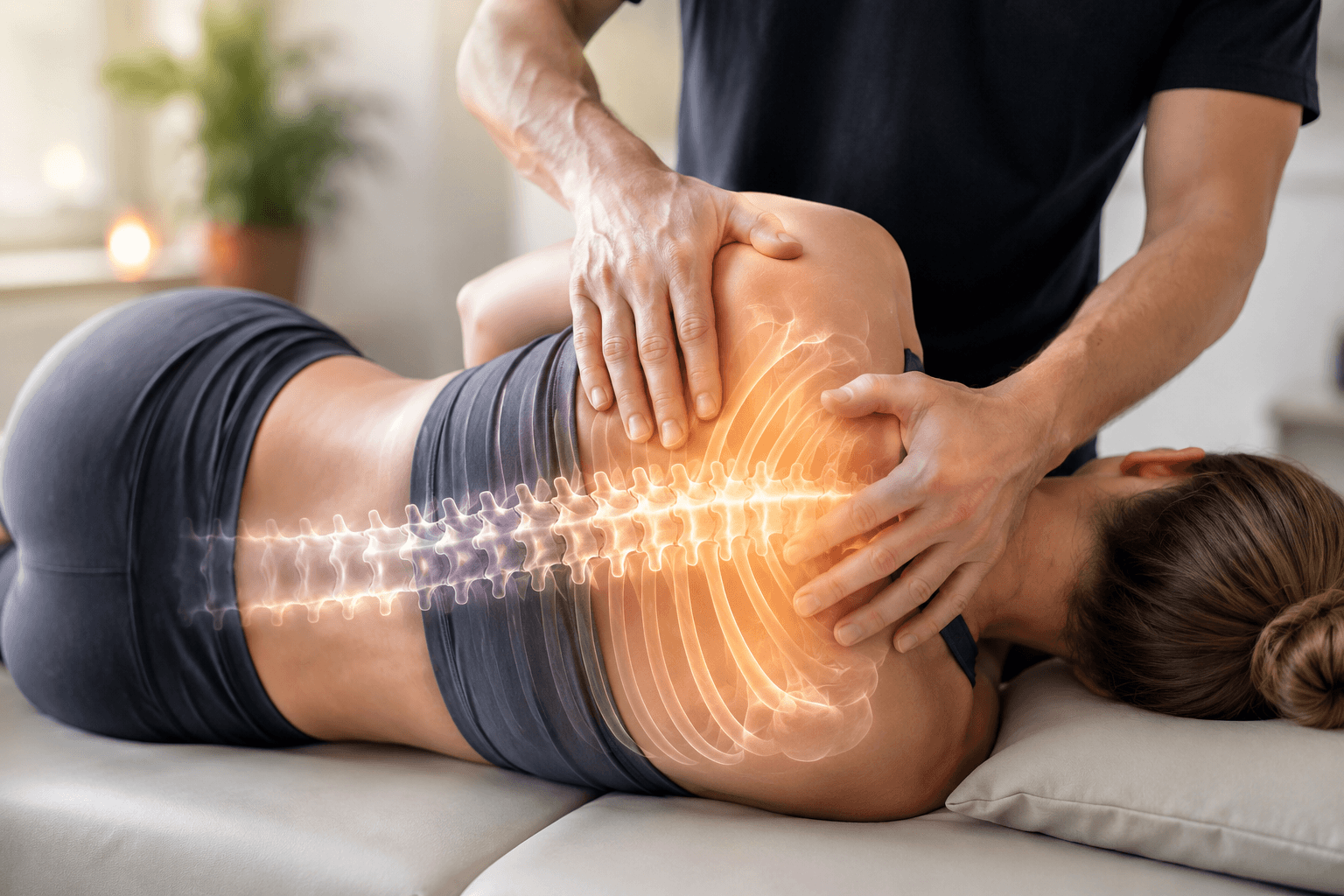
Chiropractic, manual therapy, structural osteopathy and other joint traction disciplines share the same core idea: HVLA (High Velocity, Low Amplitude) - a short, fast thrust with very small amplitude at the edge of the joint's range of motion. Colloquially it's called "cracking", though the goal of the technique isn't to produce a crack, but to release gases dissolved in the joint and the surrounding tissue. The pop itself (cavitation) - whether it happens or not - doesn't show whether the technique was performed correctly; it's simply a side effect.
Manual therapy centers on a controlled high-velocity (HVLA) thrust technique that restores the joint's normal range of motion. The process always begins with safety screening and ruling out contraindications - only then is the movement restriction assessed, and soft mobilization techniques prepare the tissue for the thrust and support the outcome afterward.
Chiropractic, manual therapy, osteopathy — one technique, different schools
The name depends on the school and the country; the work of the hands does not. Chiropractic, manual therapy and structural osteopathy all rest on the same core technique — an HVLA impulse at the joint's end range. Different training traditions gave the same manoeuvre different names.
What matters clinically is whether the technique is performed correctly and whether safety has been tested beforehand — not which school's vocabulary is used.
Who is manual therapy for?
Manual therapy helps above all when the problem is recurring, concentrated in one spot, and linked to restricted movement - not just tension.
With pelvic and SI joint complaints, typical signs include buttock pain, a sense that one leg feels longer than the other, or discomfort when standing or walking for long periods.
HVLA and its supporting techniques
The core technique of manual therapy is HVLA - a controlled high-velocity thrust. Soft mobilization techniques aren't a standalone alternative, but part of the same process: they prepare the tissue for the thrust and support the outcome afterward.
HVLA - the core of the method
A short, fast thrust with a very small amplitude at the edge of the joint's range of motion. This is the central technique of manual therapy, applied only ever after safety screening and tissue preparation.
- Speed, not force - most thrusts require almost no physical effort
- Stimulates the joint's mechanoreceptors and reduces protective muscle tension
- The accompanying "pop" is cavitation - the rapid release of gas dissolved in synovial fluid, not the joint "snapping back into place"[1]
- Always requires a prior check of stability and warning signs
Preparatory and supporting techniques
Slow, rhythmic, low-amplitude soft techniques that don't replace HVLA, but prepare the tissue for it and support the outcome after the thrust.
- Myofascial release - the soft tissue and surrounding connective tissue relax before the thrust
- Muscle energy technique (MET) - the client's own muscle contraction against controlled resistance, lowering protective tension
- Joint articulation - warms up the joint's "play" before more precise work
- Functional techniques - also suitable on their own when HVLA isn't indicated at that moment
Limb joints too
Manual therapy isn't limited to the back and neck - the same principles apply to the joints of the limbs as well.
Why restoring mobility affects more than just one spot
The body is a connected whole - tension in one place can maintain a problem somewhere else entirely.
🕸️ Fascia connects the whole body
The connective tissue (fascia) surrounding muscles, joints, and other tissues forms one continuous network. This is why tension in the chest or pelvis can maintain pain in the neck or lower back - and why the result can disappear if only the symptom's location is treated.
📡 Mechanoreceptors and pain transmission
Receptors located in the joint capsule and muscles constantly send the central nervous system information about position and tension. Stimulating them during mobilization helps reduce pain transmission in the spinal cord (the so-called gate control mechanism) and lower protective muscle tone[2].
🧘 The effect extends beyond the local area
Some clients also experience general relaxation, a calmer mind, or better sleep after a session - this is an effect at the level of the central nervous system, not just a local change[3].
🤝 The pace adapts to the client
High anxiety or fear of the procedure raises muscle tone and makes techniques uncomfortable. In that case we start more gently, explain the process in advance, and move more slowly - nothing is forced through.
What the research shows
The effectiveness of manual therapy has been studied in both the spine and the limbs. An excerpt from current scientific literature:
🦴 Neck pain and joint mobilization
A 2025 systematic review and meta-analysis confirms that cervical joint mobilization techniques reduce pain and improve function in chronic neck pain[4].
💥 HVLA and nerve root complaints
A 2025 meta-analysis showed that controlled HVLA thrust reduces pain significantly more than sham (placebo) manipulation in cervical, thoracic, and lumbar radiculopathy[5].
💊 Strong effect in acute low back pain
In a double-blind randomized trial, HVLA manipulation for acute low back pain was more effective than the anti-inflammatory painkiller diclofenac and clearly outperformed placebo, with no side effects[6].
🦶 Ankle sprain
A systematic review showed that joint mobilization and manipulation reduce pain and improve range of motion in both acute and chronic ankle sprain[7].
🦵 Knee joint pain
A review of randomized trials found that joint mobilization combined with other treatment improves pain and function in patellofemoral pain syndrome[8].
📍 Improved joint sense
A systematic review showed that both mobilization and HVLA-type manipulation measurably improve joint position sense (proprioception) immediately after the intervention[9].
- Real-Time Visualization of Joint Cavitation. PMC
- The immediate effects of passive joint mobilisation on local muscle function. ScienceDirect
- The neurophysiological effects of a single session of spinal joint mobilization: does the effect last? PMC
- Effectiveness of Manual Joint Mobilization Techniques in the Treatment of Nonspecific Neck Pain: Systematic Review With Meta-Analysis. JOSPT, 2025
- Efficacy of Spine High-Velocity Low-Amplitude Thrust Manipulations in Patients With Radiculopathy: Systematic Review With Meta-Analysis. JOSPT, 2025
- Spinal high-velocity low amplitude manipulation in acute nonspecific low back pain: RCT vs. diclofenac and placebo. PubMed
- The efficacy of manual joint mobilisation/manipulation in treatment of lateral ankle sprains: a systematic review. PubMed
- The effects of joint mobilization on individuals with patellofemoral pain: a systematic review. PubMed
- The Effect of Joint Mobilization and Manipulation on Proprioception: Systematic Review with Limited Meta-Analysis. PMC
ℹ️ The information on this page is for informational purposes only and does not replace professional medical diagnosis or treatment.
How a session works
1. Safety screening
Ruling out contraindications and checking stability - this is always the first step, before any touch at all.
2. Assessment
Mapping posture, movement pattern, and the exact location and direction of the restriction.
3. Tissue preparation
Soft techniques relax the tissue and prepare the joint for the HVLA thrust.
4. HVLA thrust
A short, controlled action on the restriction found - the core technique of manual therapy.
5. Follow-up check
Re-assessing mobility and how you feel, along with recommendations going forward.
The same principle applies at every step: if the tissue isn't ready for the technique or it doesn't suit the client, a gentler approach is chosen. Knowing when to hold back from a technique is just as important a part of professionalism as skillfully performing it.
Contraindications
Manual therapy is safe for most people, but certain conditions call for caution, or for the technique - especially HVLA - to be avoided altogether. Please always let us know about these before a session.
We don't perform it - we refer you to a doctor
- Recent fracture or suspicion of one
- Known tumor or metastasis in bone
- Acute infection (e.g. osteomyelitis, septic arthritis)
- Severe osteoporosis
- Acute joint or ligament instability (e.g. recent trauma)
- Complete (grade III) ligament tear
- Marked hypermobility or connective tissue disease (e.g. Ehlers-Danlos syndrome)
- Acute vascular insufficiency (e.g. signs of vertebral artery insufficiency)
Requires caution - please tell us about this
- Pregnancy, especially the 1st and 3rd trimester
- Use of blood-thinning medication
- Rheumatoid arthritis or other autoimmune disease
- Older age combined with reduced bone density
- Strong anxiety or fear of hands-on procedures
Additionally for HVLA - a higher threshold
- Any suspicion of upper cervical ligament instability
- Unexplained dizziness or visual disturbances when moving the neck
- Spondylolisthesis (grade 2 or higher)
- Acute-phase disc herniation
- Acute radiculopathy with a worsening neurological deficit
What to expect after a session
Most reactions are temporary and a normal part of the body's adaptation.
Local tenderness
Mild sensitivity in the treated area for 2–3 days, similar to post-workout muscle soreness.
Mild dizziness
Especially after work on the neck area - transient, related to a temporary recalibration of the balance system.
Autonomic reactions
Drowsiness, a feeling of warmth, mild sweating, or emotional release - all normal parts of the body's response.
What to do
Drink enough water, avoid strenuous exercise and heavy lifting for 24 hours - a light walk is recommended.
Movement that's become restricted doesn't have to stay that way
Manual therapy gives back the mobility you've come to take for granted - in a controlled way and at your own pace. Book an appointment and see what changes.
Manual therapy (chiropractic) at Viimsi Hospital is also a great choice for clients from the Merivälja and Pirita areas who want hands-on mobility treatment close to home.
Frequently asked questions
Related services
Manual therapy is often combined with: