 Invoice
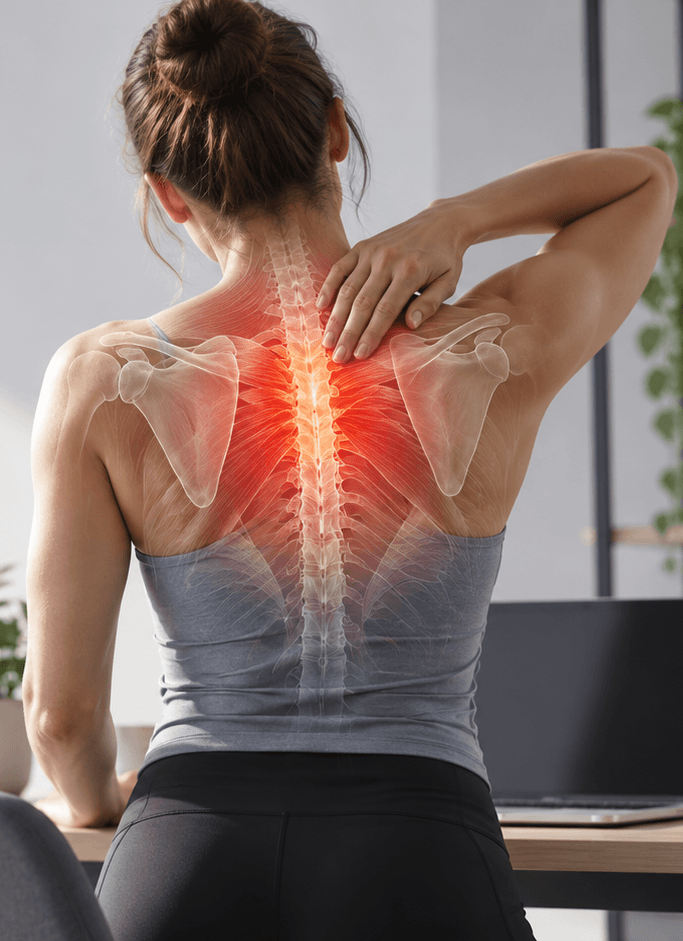
Shoulder blade and upper back pain – causes, muscles and treatment
When to see a doctor or call 112
- Call 112 if pain in the chest or between the shoulder blades comes with shortness of breath, cold sweat, nausea or pain spreading to the left arm, neck or jaw.
- Call 112 for sudden, very severe, tearing pain in the middle of the back.
- Pain after a fall, accident or other trauma – with osteoporosis even after minor trauma – needs a doctor's assessment first.
- Weakness or numbness in the legs and unsteady walking need an immediate doctor's assessment.
- A history of cancer, unexplained weight loss or constant night pain that does not depend on position need a doctor's assessment before treatment.
How the pain shows up
Pain between the shoulder blades
Dull, burning or pressing pain between the spine and the inner border of the shoulder blade. It is often linked to tension in the rhomboids and middle trapezius and gets worse with computer work, driving and carrying loads.
Pain under or along the shoulder blade
Deep pain under the shoulder blade or along its inner border, which may spread to the shoulder and arm. Trigger points in the serratus posterior superior, infraspinatus or levator scapulae are often behind it.
Upper back stiffness
A stiff feeling in the thoracic spine, especially in the morning or after long sitting. The back does not bend or rotate freely and straightening up feels hard. Restoring mobility of the thoracic vertebrae often brings quick relief.
Sharp pain on deep breathing or turning
Stabbing pain on one side of the spine that appears with a deep breath, coughing or turning the body. The cause is often restricted movement of a joint between a rib and the spine, together with protective tension in the surrounding muscles.
Pain referred from the neck or shoulder
The joints and muscles of the lower neck and the shoulder girdle muscles can refer pain between the shoulder blades. That is why we always assess the neck and shoulders as well.
Muscles that commonly cause shoulder blade and upper back pain
According to the classic description of myofascial pain (Travell and Simons), each muscle has its own typical referred pain pattern. Pain felt between the shoulder blades may come from the local muscles or from muscles of the neck, shoulder or front of the chest. The patterns are a guide, not a diagnosis.
Rhomboids (mm. rhomboidei)
Draw the shoulder blades towards the spine and hold them in place. Typical is a superficial, dull ache between the inner border of the shoulder blade and the spine that does not ease with movement. Overloaded when the shoulders stay rounded forward.
Middle and lower trapezius (m. trapezius)
Stabilise the shoulder blades and keep the shoulders back. Middle trapezius pain is burning and sits between the shoulder blades near the spine; the lower part may refer pain above the shoulder blade and to the upper neck.
Levator scapulae
Elevates the shoulder blade and helps turn the head. Pain appears at the angle of the neck and shoulder and radiates down along the inner border of the shoulder blade.
Serratus posterior superior
Lies under the shoulder blade and lifts the upper ribs during inhalation. Typical is a deep ache under the upper part of the shoulder blade that may spread to the back of the shoulder, the forearm and the little finger.
Serratus anterior
Holds the shoulder blade against the chest wall and takes part in deep breathing. Pain is felt on the side of the chest and near the lower angle of the shoulder blade; tension can make a deep breath feel difficult.
Infraspinatus
Rotates the upper arm outwards and stabilises the shoulder joint. Pain is felt deep in the front of the shoulder and in the arm, and also along the inner border of the shoulder blade.
Erector spinae (thoracic part)
A long muscle alongside the spine that keeps the body upright. Pain is local, along the spine; the deep small muscles between the vertebrae beneath it influence vertebral mobility.
Pectoralis minor
Pulls the shoulder blade forwards and down. A short, tight pectoralis minor rounds the shoulders and increases tension in the muscles between the shoulder blades; pain may spread to the front of the chest and the inner arm.
Why it hurts between the shoulder blades
Sitting posture and rounded shoulders. Computer and phone work keeps the shoulders forward and the head poking out. The muscles between the shoulder blades work in a stretched position for hours, tire and become painful.
Prolonged static load. Muscles that hold tension in one position for a long time get less blood supply. Metabolic by-products build up and pain sensitivity increases.
Myofascial trigger points. Sensitive, taut knots form in an overloaded muscle and cause both local and referred pain. That is why the pain is not always where its source is.
Reduced mobility of the thoracic vertebrae and ribs. When the thoracic spine and rib joints stiffen, the surrounding muscles carry more load and pain appears on breathing in or turning.
Breathing muscle tension and stress. Shallow chest breathing loads the muscles of the neck and upper ribs. Stress keeps the shoulder girdle constantly tense and increases pain sensitivity.
How our methods help
Medical massage
Working on the muscles of the upper back, shoulder girdle and neck reduces muscle tension and pain and improves blood supply. Massage works especially well on tired muscles between the shoulder blades.
Trigger point therapy
With controlled pressure and stretching we treat trigger points in the rhomboids, trapezius, levator scapulae, serratus muscles and infraspinatus. The aim is to reduce referred pain and restore normal muscle length.
Manual therapy and thoracic mobilisation
Mobilisation and, where appropriate, an HVLA thrust restore mobility of the thoracic vertebrae and rib joints. This reduces pain and often brings immediate relief when breathing and turning. Before choosing a technique we always carry out a thorough assessment and tests.
Deep tissue massage
Slow, deep work reaches the deeper muscle layers and connective tissue, for example around a long-term tense erector spinae and the rhomboids. Well suited to chronic upper back tension.
Cupping massage
The vacuum lifts the tissues and improves local blood supply. Cups suit the large muscle surfaces of the upper back well and quickly release tension built up between the shoulder blades.
Gua sha
Treatment with a special scraping tool reduces tension and pain and improves tissue mobility in the neck and upper back.
High-intensity magnetic therapy (EMTT)
The magnetic field reaches deep into the tissues and helps ease muscle tension and pain. We often use it together with massage.
Kinesiotaping
Tape provides feedback through the skin, supports shoulder position and helps keep the treatment result between sessions.
What the research shows
Treatment of upper back, neck and shoulder girdle pain has been studied extensively. Below is a summary of randomised trials, systematic reviews and meta-analyses that support the methods we use.
Manipulation reduces thoracic pain
In a randomised trial, thoracic spinal manipulation reduced mechanical thoracic spine pain more than a sham treatment and improved side bending of the spine [2]
Thoracic manipulation also helps neck pain
In a meta-analysis of 18 randomised trials with 914 neck pain patients, thoracic spine manipulation reduced neck pain and improved neck mobility and daily function; no serious side effects occurred [3]
Pressure technique for trigger points
In a meta-analysis of 15 randomised trials with 725 neck pain patients, ischaemic compression of trigger points reduced pain, raised the pain threshold and improved mobility more than sham treatment or no treatment [4]
Massage reduces neck and shoulder pain
In a meta-analysis of 12 studies, massage reduced neck and shoulder girdle pain compared with inactive treatment [5]
Cupping
In a meta-analysis of 18 randomised trials, cupping reduced neck pain and improved function compared with no treatment and gave additional benefit together with other treatments [6]
Gua sha
In a randomised trial in chronic neck pain patients, a single gua sha session reduced neck pain and pain on movement over one week significantly more than a heat pad and improved daily function and quality of life; the treatment was well tolerated [7]
How a course of treatment works
1. 1. Assessment
A conversation about your symptoms, their duration and your health, a check for warning signs, and testing of thoracic, neck and shoulder mobility and the muscles. We find the muscles and joints that cause the pain.
2. 2. Relieving pain and tension
In the first sessions: muscle work, trigger point treatment and thoracic mobilisation. During the active phase we recommend coming back after 4–7 days.
3. 3. Restoring mobility
Once the pain has eased, we focus on the mobility of the thoracic spine and shoulder girdle and on releasing deeper tension. We give advice on your work posture and everyday load. The treatment plan is adjusted based on the assessment at the start of each session.
4. 4. Maintenance
After the active phase, regular maintenance sessions help keep the result and prevent flare-ups; appointments can be arranged as needed.
What you can do yourself
- Change position every 30–45 minutes at the computer: stand up, move your shoulders and stretch your back.
- Place the screen at eye level and bring the keyboard and mouse close to your body so your shoulders do not round forward.
- Heat (a warm shower, a heat pack) eases muscle tension between the shoulder blades.
- A few times during the working day, take calm deep breaths into your belly and lower ribs – this reduces tension in the neck and upper back muscles.
- Carry your bag on alternate shoulders or use a backpack.
- If the pain keeps returning or does not ease, book an appointment – the sooner tension is released, the faster movement returns.
Book an upper back assessment
Book an assessment at Viimsi Hospital (Ravi tee 4) or in Pärnu (Rüütli 47). We will find out which muscles and joints are involved and agree on a suitable treatment plan.
Frequently asked questions
Related services and topics
References
- Briggs AM, Smith AJ, Straker LM, Bragge P. Thoracic spine pain in the general population: prevalence, incidence and associated factors in children, adolescents and adults. A systematic review. BMC Musculoskelet Disord. 2009;10:77. doi.org/10.1186/1471-2474-10-77
- Schiller L. Effectiveness of spinal manipulative therapy in the treatment of mechanical thoracic spine pain: a pilot randomized clinical trial. J Manipulative Physiol Ther. 2001;24(6):394-401. doi.org/10.1067/mmt.2001.116420
- Yang J, Zhao S, Zhang R, Huang C, Huang KY, Cheng Y, He CQ, Li LX. Effectiveness and safety of thoracic manipulation in the treatment of neck pain: An updated systematic review and meta-analysis. Technol Health Care. 2024;32(S1):385-402. doi.org/10.3233/THC-248034
- Xu A, Huang Q, Rong J, Wu X, Deng M, Ji L. Effectiveness of ischemic compression on myofascial trigger points in relieving neck pain: A systematic review and meta-analysis. J Back Musculoskelet Rehabil. 2023;36(4):783-798. doi.org/10.3233/BMR-220045
- Kong LJ, Zhan HS, Cheng YW, Yuan WA, Chen B, Fang M. Massage therapy for neck and shoulder pain: a systematic review and meta-analysis. Evid Based Complement Alternat Med. 2013;2013:613279. doi.org/10.1155/2013/613279
- Kim S, Lee SH, Kim MR, Kim EJ, Hwang DS, Lee J, Shin JS, Ha IH, Lee YJ. Is cupping therapy effective in patients with neck pain? A systematic review and meta-analysis. BMJ Open. 2018;8(11):e021070. doi.org/10.1136/bmjopen-2017-021070
- Braun M, Schwickert M, Nielsen A, Brunnhuber S, Dobos G, Musial F, Lüdtke R, Michalsen A. Effectiveness of traditional Chinese "gua sha" therapy in patients with chronic neck pain: a randomized controlled trial. Pain Med. 2011;12(3):362-369. doi.org/10.1111/j.1526-4637.2011.01053.x
The information on this page is for informational purposes only and does not replace a doctor's diagnosis or treatment. If you have warning signs, see a doctor or call 112.