 Invoice
Muscle cramps and night calf cramps – causes, muscles and treatment
When to see a doctor or call 112
- Swelling, redness, warmth and pain in one calf that do not go away – see a doctor immediately (possible deep vein thrombosis). If shortness of breath or chest pain develops, call 112.
- Cramps together with persistent muscle weakness, muscle wasting or numbness need a doctor's assessment.
- If cramps started after beginning a new medication or have become very frequent, discuss it with your doctor.
Types of cramps
Night calf cramps
The most common form: a cramp grips the calf or sole of the foot during sleep or on waking. At night the foot is often pointed and the calf muscle shortened, which makes a cramp more likely. The muscle may stay tender for days afterwards.
Exercise-related cramps
These occur during or after training – after a long run, cycling, swimming or standing for a long time. In a tired muscle the neuromuscular control changes and the muscle cramps more easily.
Hamstring and thigh cramps
A cramp in the back or front of the thigh often comes on during a sprint, a jump or after long sitting. Tight hamstrings are also a common companion of knee and back pain.
Foot and toe cramps
The toes curl or the sole of the foot locks up. Tight shoes, long standing and tense small muscles of the sole make this more likely.
Cramps in pregnancy and later life
In the second half of pregnancy and in later life calf cramps are more common, as muscle load and circulation change. Gentle massage in a comfortable position suits these situations too.
Muscles that commonly cramp
According to the classic description of myofascial pain (Travell and Simons), each muscle has its own typical pain pattern. A muscle with trigger points is more sensitive and cramps more easily. In the assessment we look for exactly these areas.
Gastrocnemius (m. gastrocnemius)
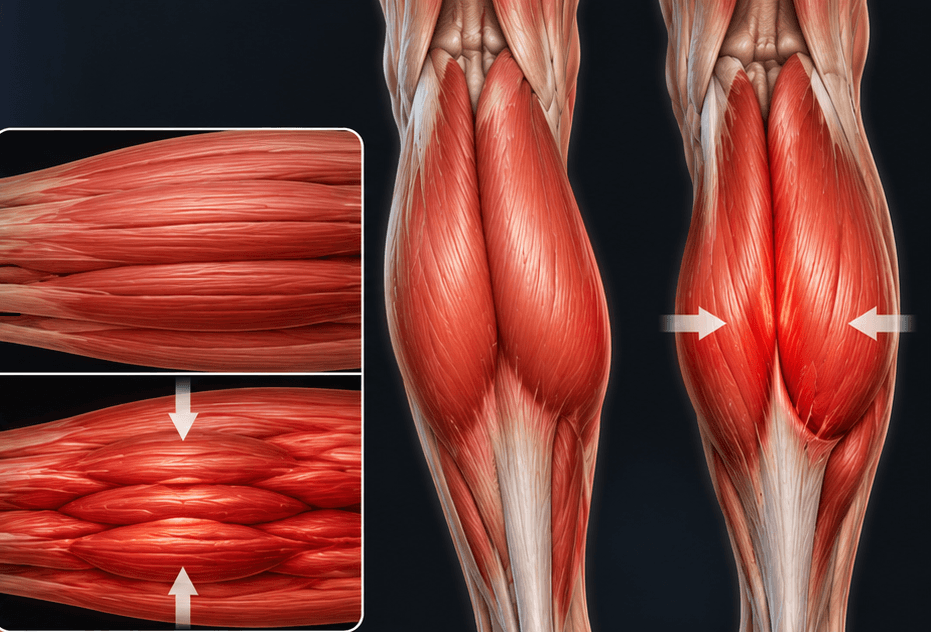
The muscle that cramps most often. It bends the knee and points the foot. Trigger points cause pain at the back of the calf, behind the knee and in the inner arch of the foot, and have been linked to night calf cramps.
Soleus (m. soleus)
Lies under the gastrocnemius and carries much of the load of standing and walking. Pain radiates to the heel and lower calf; a tight soleus limits ankle mobility.
Hamstrings (m. biceps femoris, m. semitendinosus, m. semimembranosus)
Bend the knee and extend the hip. Cramps often come on during sprinting and after long sitting. Pain is felt below the buttock crease, at the back of the thigh and behind the knee.
Quadriceps (m. quadriceps femoris)
Straightens the knee and carries the load on stairs and downhill. When tired it may cramp at the front of the thigh; trigger points refer pain around the knee.
Long toe flexors (m. flexor digitorum longus, m. flexor hallucis longus)
Curl the toes and support the arch of the foot. A cramp pulls the toes into a curl; pain is felt in the sole and under the toes.
Small muscles of the sole
Small muscles in the sole that hold the arch and help balance. Tight shoes and long standing overload them; a cramp makes the sole lock up with sharp pain.
Why a muscle cramps
Muscle fatigue and neuromuscular control. Research shows that a cramp arises mainly when the excitability of the nerve cells controlling the muscle changes – especially in a tired, overloaded muscle. The signals that inhibit the muscle weaken and it fails to relax.[2][3]
Myofascial trigger points. Sensitive, taut knots in a muscle can set off a cramp. In an experiment, stimulating trigger points in the calf muscle triggered a cramp, while stimulating other areas of the muscle did not.[4]
A muscle in a shortened position. At night the foot is often pointed and the blanket pushes the toes down – the calf muscle stays shortened for hours and cramps more easily.
Tense, stiff muscles. Long sitting, standing and repetitive one-sided load make muscles stiff and reduce their blood supply and recovery.
Conditions and life stages. Hot weather, sweating, pregnancy and age make cramps more likely, as muscle load and circulation change. The main factor, however, is considered to be muscle fatigue rather than a lack of salts.[1][3]
How our methods may help
Medical massage
Working on the calf, thigh and foot muscles reduces muscle tension, improves blood supply and restores the muscle's elasticity. A relaxed muscle cramps less often, and a cramp leaves less pain behind.
Trigger point therapy
We find and treat trigger points in the gastrocnemius, soleus, hamstrings and sole of the foot with controlled pressure and stretching. These points can set off cramps – releasing them helps reduce cramps.
Therapeutic sports massage
For athletes and active people: speeds up muscle recovery after exercise, eases muscle soreness and lowers the risk of fatigue-related cramps.
Lymphatic massage
A gentle rhythmic technique that eases heavy, swollen legs and improves circulation – well suited to cramps from long standing and during pregnancy.
Foot massage
Working on the muscles and connective tissue of the sole and toes releases the tension that curls the toes and restores mobility of the arch.
High-intensity magnetic therapy (EMTT)
The magnetic field reaches deep into the muscle and helps release tension and ease pain. We often use it together with massage.
What the research shows
How muscle cramps develop has been studied extensively. Below is a summary of reviews and randomised trials that explain the causes of cramps and support the methods we use.
Night leg cramps are very common
Up to 60% of adults have experienced night leg cramps. Muscle fatigue and nerve function are considered more important causes than electrolyte disturbances [1]
A cramp starts in the interplay of nerve and muscle
According to reviews, cramps arise mainly from changes in the excitability of the nerve cells controlling the muscle, and the main mechanism is altered nerve control of a tired muscle [2][3]
Trigger points can set off a cramp
In a controlled experiment, stimulating latent trigger points in the calf muscle caused a cramp in 13 of 14 participants, while stimulating other areas of the muscle did not [4]
Treating trigger points reduced night cramps
Trigger points were found in the calf muscle of patients with night calf cramps, and after these trigger points were treated the cramps decreased – trigger points are an important target in cramps [5]
Massage reduced cramps and improved sleep
In a randomised trial in haemodialysis patients, leg massage reduced the frequency and severity of cramps and improved sleep quality [6]
Leg massage reduced cramps at home too
In another randomised trial in haemodialysis patients, a 20-minute leg massage during dialysis reduced cramps at home by an average of 1.3 episodes a week, compared with 0.2 in the control group [7]
Massage eases muscle soreness after exercise
In a meta-analysis of 11 studies, massage reduced muscle soreness 24, 48 and 72 hours after intense exercise and improved muscle strength [8]
How a course of treatment works
1. 1. Assessment
A conversation about how often and when cramps occur and under what load, checking for warning signs, and assessing the muscles and trigger points of the calf, thigh and foot. If needed, we refer you to a doctor before starting treatment.
2. 2. Releasing tension
In the first sessions we release tension in the gastrocnemius, soleus and other cramping muscles and treat trigger points. During the active treatment phase it is recommended to return within 4–7 days.
3. 3. Restoring muscle elasticity
As cramps become less frequent, we focus on the elasticity and blood supply of the muscles and give advice on sleeping position, footwear and everyday load.
4. 4. Maintenance
After the active phase, regular maintenance sessions help keep the result and prevent flare-ups; appointments can be arranged as needed.
What you can do yourself
- During a cramp, straighten the leg and pull the toes towards you, or press the heel into the floor and walk a few steps – this releases the cramp faster.
- Drink enough during the day, especially in hot weather and after training.
- Keep the blanket loose over your feet so it does not push the toes down at night.
- A warm shower or hot water bottle before bed relaxes the calf muscles.
- Move during the day and change position when sitting or standing for long periods.
- Wear comfortable shoes with a roomy toe box.
Book a muscle assessment
Book an assessment at Viimsi Hospital (Ravi tee 4) or in Pärnu (Rüütli 47). We will find out which muscles are causing the cramps and agree on a suitable treatment plan.
Frequently asked questions
Related services and topics
References
- Allen RE, Kirby KA. Nocturnal leg cramps. Am Fam Physician. 2012;86(4):350-355. pubmed.ncbi.nlm.nih.gov/22963024/
- Minetto MA, Holobar A, Botter A, Farina D. Origin and development of muscle cramps. Exerc Sport Sci Rev. 2013;41(1):3-10. doi.org/10.1097/JES.0b013e3182724817
- Schwellnus MP. Cause of exercise associated muscle cramps (EAMC) – altered neuromuscular control, dehydration or electrolyte depletion? Br J Sports Med. 2009;43(6):401-408. doi.org/10.1136/bjsm.2008.050401
- Ge HY, Zhang Y, Boudreau S, Yue SW, Arendt-Nielsen L. Induction of muscle cramps by nociceptive stimulation of latent myofascial trigger points. Exp Brain Res. 2008;187(4):623-629. doi.org/10.1007/s00221-008-1331-y
- Prateepavanich P, Kupniratsaikul V, Charoensak T. The relationship between myofascial trigger points of gastrocnemius muscle and nocturnal calf cramps. J Med Assoc Thai. 1999;82(5):451-459. pubmed.ncbi.nlm.nih.gov/10443094/
- Parlak AG, Akgün Şahin Z. The effect of massage on cramp frequency, cramp severity, and sleep quality of hemodialysis patients: A randomized controlled trial. Hemodial Int. 2024;28(4):405-418. doi.org/10.1111/hdi.13169
- Mastnardo D, Lewis JM, Hall K, Sullivan CM, Cain K, Theurer J, Huml A, Sehgal AR. Intradialytic Massage for Leg Cramps Among Hemodialysis Patients: a Pilot Randomized Controlled Trial. Int J Ther Massage Bodywork. 2016;9(2):3-8. doi.org/10.3822/ijtmb.v9i2.305
- Guo J, Li L, Gong Y, Zhu R, Xu J, Zou J, Chen X. Massage Alleviates Delayed Onset Muscle Soreness after Strenuous Exercise: A Systematic Review and Meta-Analysis. Front Physiol. 2017;8:747. doi.org/10.3389/fphys.2017.00747
The information on this page is for informational purposes only and does not replace a doctor's diagnosis or treatment. If you have warning signs, see a doctor or call 112.