 Invoice
Achilles tendon and shin pain – causes, muscles and treatment
When to see a doctor straight away
- Sudden sharp pain or a feeling of being “kicked” above the heel, after which you cannot rise onto your toes – possible tendon rupture. Go to the emergency department straight away.
- Swelling, redness, warmth and pain in the calf without obvious strain (possible thrombosis) – see a doctor the same day; if you are short of breath or have chest pain, call 112 immediately.
- Pinpoint pain at one spot on the shinbone that persists at rest or at night (possible stress fracture) – needs a doctor's assessment.
Common forms of shin and calf pain
Mid-portion Achilles tendon pain
Pain and thickening in the middle of the tendon, 2–6 cm above the heel. The tendon is stiff and painful in the morning, pain comes at the start of activity and may ease once warmed up. Common in runners and jumping athletes.
Insertional (heel-end) pain
Pain where the tendon attaches to the heel bone. It gets worse walking uphill, on stairs and in shoes with stiff heel counters. Also common in people who train less.
Pain along the shinbone (“shin splints”)
Diffuse pain along the inner edge of the lower two-thirds of the shinbone that comes on during running or jumping. Common with a rapid increase in running load, on hard surfaces and in worn-out shoes.
Calf muscle tension and stiffness
The calf muscles are tight, ankle mobility decreases and the calves tire quickly. The tension increases the load on the Achilles tendon and often precedes tendon pain.
Muscles that commonly cause shin and calf pain
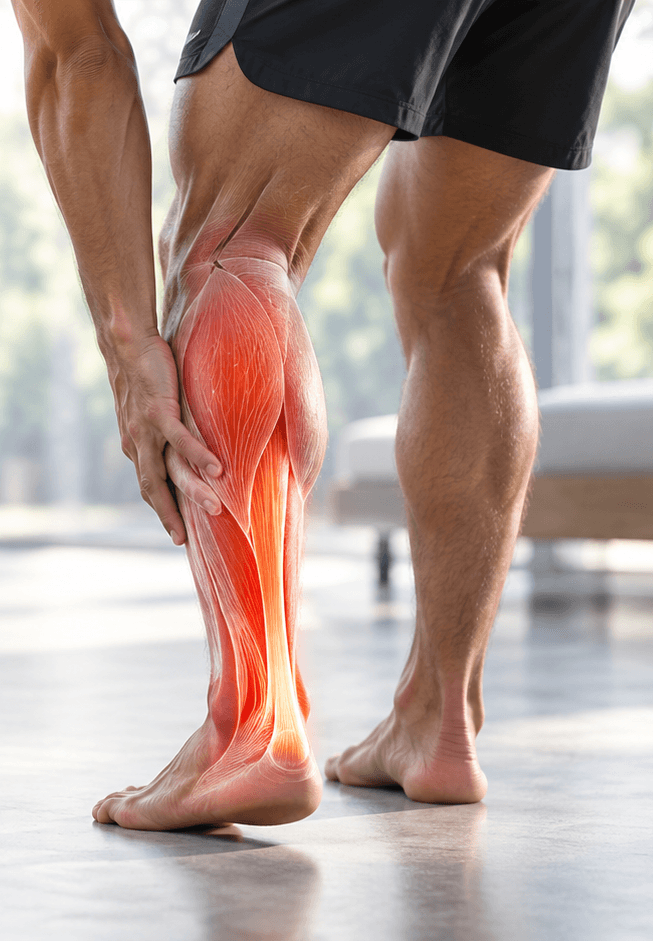
According to the classic description of myofascial pain (Travell and Simons), each muscle has its own typical referred pain pattern. Pain is not always felt where the problem is – for example, pain from the soleus may be felt in the heel. The patterns are a guide, not a diagnosis.
Gastrocnemius
Plantarflexes the ankle, flexes the knee and provides push-off when walking and running. Trigger points refer pain to the calf, the back of the knee and the inner arch of the foot. A tight gastrocnemius directly increases the load on the Achilles tendon.
Soleus
A deeper calf muscle that carries much of your body weight when standing and running. Trigger points refer pain behind and under the heel and to the Achilles tendon area. A tight soleus restricts ankle dorsiflexion.
Tibialis posterior
Supports the inner arch and controls the foot rolling inwards. Pain refers to the Achilles tendon, the middle of the calf and the sole. Overload is linked to pain along the inner edge of the shinbone.
Flexor digitorum longus
Flexes the toes and supports the arch. Pain refers to the middle of the sole and the inner side of the shin. Loaded by running and hard surfaces.
Tibialis anterior
Lifts the foot and brakes the landing. Pain refers to the front of the ankle and the big toe. Loaded by downhill running and a rapid increase in running load.
Fibularis (peroneus) longus
Stabilises the ankle and the outer edge of the foot. Pain refers around the outer ankle bone and along the outer shin. Loaded on uneven ground and after an ankle sprain.
Why the Achilles tendon and shins hurt
Tendon overload. A tendon adapts to load slowly. When running volume, speed or jumping increase faster than the tendon can recover, overload pain develops.
Calf muscle tension. A tight gastrocnemius and soleus pull on the tendon constantly and restrict ankle mobility, so the load on the tendon and the area around the shinbone increases with every step. In a study, restricted ankle dorsiflexion was associated with a higher risk of overuse injuries.[5]
Myofascial trigger points. Sensitive, taut areas in the calf muscles cause referred pain to the heel and tendon and reduce muscle elasticity.
Foot shape and footwear. Flat or very high arches, worn-out or unsuitable shoes and hard surfaces change how load is distributed and increase the strain on the lower leg.[5]
Sudden changes in load. A new training plan, preparing for a race, new shoes or switching from soft ground to asphalt are common triggers of pain.
How our methods may help
Shockwave therapy
Acoustic pulses are directed at the painful tendon and the area around the shinbone. Shockwave reduces chronic Achilles tendon and shin pain and improves function.[1][2][3] Usually 3–6 sessions 4–7 days apart.
Therapeutic sports massage
Working on the gastrocnemius, soleus and deep calf muscles reduces tension, improves ankle mobility and eases the load on the tendon. Fits well alongside training.
Trigger point therapy
With controlled pressure we release trigger points in the soleus, gastrocnemius and tibialis posterior that refer pain to the heel and tendon. In a study, pressure release of soleus trigger points immediately improved ankle mobility.[4]
Deep tissue massage
Slow, deep work reaches the soleus and the deep calf muscles and connective tissue that have become tight from long-term load.
High-intensity magnetic therapy (EMTT)
We use it to ease muscle tension and pain in the tendon and calf area, often together with shockwave or massage. The procedure is painless.
Kinesiotaping
Tape provides feedback through the skin and supports the tendon and calf muscles when walking and training between sessions.
What the research shows
Treatment of Achilles tendon and shin pain has been studied extensively. Below is a summary of a meta-analysis and clinical studies that support the methods we use.
Shockwave reduces Achilles tendon pain
According to a meta-analysis of eight studies, shockwave therapy reduced pain in Achilles tendinopathy and improved function and patient satisfaction more than the comparison treatments [1]
Shockwave for insertional tendon pain
In chronic insertional Achilles tendinopathy, 83% of patients who received shockwave therapy had a successful result, and pain decreased significantly more than in the control group [2]
Shockwave for pain along the shinbone
In people with long-standing pain along the shinbone (MTSS), significantly more people recovered in the shockwave group than in the group without shockwave [3]
Soleus trigger point work improves mobility
In a randomised trial, pressure release of soleus trigger points immediately improved ankle mobility compared with an untreated control group [4]
Ankle mobility and overuse injuries
In a prospective study of 449 participants, restricted ankle dorsiflexion and flat or high-arched feet were associated with a higher risk of lower-limb overuse injuries [5]
How the course of treatment works
1. 1. Assessment and safety
A conversation about your symptoms, training load and footwear, a check for warning signs, palpation of the tendon and calf muscles and an assessment of ankle mobility. If needed, we refer you to a doctor before starting treatment.
2. 2. Easing pain and tension
Shockwave, calf massage and trigger point work. During the active treatment phase we recommend coming back after 4–7 days.
3. 3. Restoring mobility and adjusting load
Once the pain has eased, we focus on calf muscle elasticity and ankle mobility and give advice on load and footwear so you can return to your usual training.
4. 4. Maintenance
After the active phase, regular maintenance sessions help keep the result and prevent flare-ups; appointments can be arranged as needed.
What you can do yourself
- Temporarily reduce the load that provokes pain – shorter distances, fewer jumps and less uphill running – but do not stop moving altogether.
- Increase running volume and speed gradually, not everything at once.
- Replace worn-out running shoes and choose footwear whose heel counter does not press on the tendon.
- Choose softer ground where possible, especially during a flare-up.
- Warmth on the calves may ease muscle tension; after activity you can briefly apply cold to a painful tendon.
- If the pain does not ease or gets worse, do not train through it – come in for an assessment.
Book an assessment of your tendon and calf
Book an assessment at Viimsi Hospital (Ravi tee 4) or in Pärnu (Rüütli 47). We will find out which muscles and tendons are involved and agree on a suitable treatment plan.
Frequently asked questions
Related services and topics
References
- Fan Y, Feng Z, Cao J, Fu W. Efficacy of Extracorporeal Shock Wave Therapy for Achilles Tendinopathy: A Meta-analysis. Orthop J Sports Med. 2020;8(2):2325967120903430. doi.org/10.1177/2325967120903430
- Furia JP. High-energy extracorporeal shock wave therapy as a treatment for insertional Achilles tendinopathy. Am J Sports Med. 2006;34(5):733-740. doi.org/10.1177/0363546505281810
- Rompe JD, Cacchio A, Furia JP, Maffulli N. Low-energy extracorporeal shock wave therapy as a treatment for medial tibial stress syndrome. Am J Sports Med. 2010;38(1):125-132. doi.org/10.1177/0363546509343804
- Grieve R, Clark J, Pearson E, Bullock S, Boyer C, Jarrett A. The immediate effect of soleus trigger point pressure release on restricted ankle joint dorsiflexion: A pilot randomised controlled trial. J Bodyw Mov Ther. 2011;15(1):42-49. doi.org/10.1016/j.jbmt.2010.02.005
- Kaufman KR, Brodine SK, Shaffer RA, Johnson CW, Cullison TR. The effect of foot structure and range of motion on musculoskeletal overuse injuries. Am J Sports Med. 1999;27(5):585-593. doi.org/10.1177/03635465990270050701
The information on this page is for informational purposes only and does not replace a doctor's diagnosis or treatment. If you have warning signs, see a doctor or call 112.